
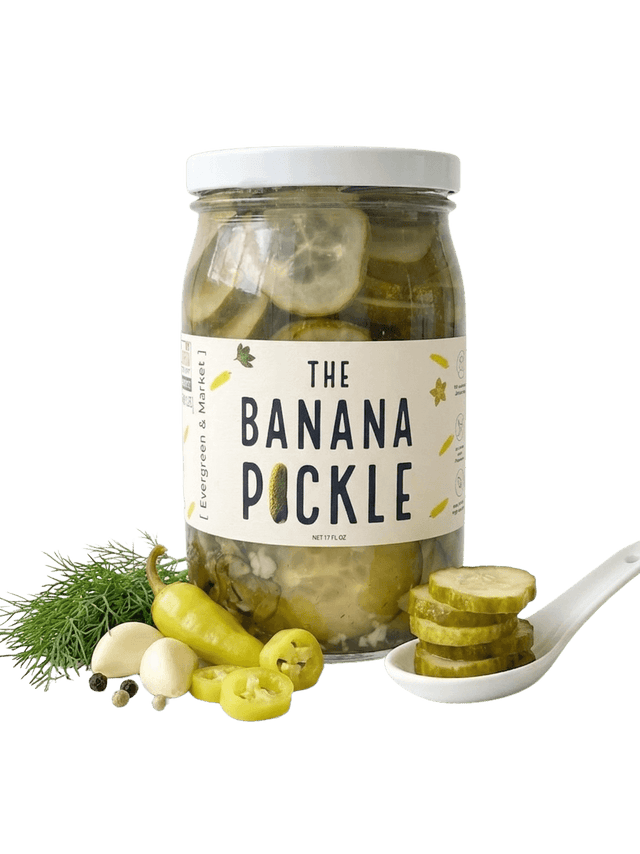
The Banana Pickle
Named for banana peppers, not bananas, and it is not spicy. It tastes like a well-balanced garlic dill with a touch of sweet.
$16.95
Free US shipping on any 2+ jars · Spend $150, get a free jar

Ever wondered what actually happens inside a pickle jar? Pickling is one of humanity's oldest food technologies — archaeologists trace it back over 4,000 years to Mesopotamia — and it's a beautiful piece of applied chemistry. Here's the science behind every crunchy bite, and why the way a pickle is made matters more than most people realize.
Vinegar-brined pickles (the style we handcraft at Atlanta Pickles) rely on acetic acid. When vegetables are submerged in an acidified brine, the acid lowers the pH below the threshold where spoilage bacteria can survive — typically below 4.6. That's why a properly brined jar is shelf-stable for up to two years without any harmful preservatives. The acid does most of the preserving, exactly the way it has for millennia.
Mass-market brands often add artificial dyes like Yellow 5 and additives like Polysorbate 80 — not because the pickle needs them, but because industrial supply chains do. A small-batch producer working with fresh produce simply doesn't need those shortcuts. That's why our jars keep the ingredient list short and simple: produce, vinegar, garlic, dill and spices, with no artificial dyes and no harmful preservatives.
Crunch is about pectin — the structural polysaccharide in vegetable cell walls. Three things destroy it: time between harvest and jar, heat over-processing, and enzymes from blossom ends. Three things protect it: fresh produce, careful low-heat handling, and calcium ions that cross-link pectin strands.
This is where sourcing becomes science. Produce starts losing cell-wall integrity within hours of harvest. A cucumber that spent three weeks in a distribution network before pickling will never crunch like one that went from a Georgia farm into a brine the same week. It's the single biggest reason handcrafted pickles taste different — and why we build our entire process around fresh, locally grown Southern produce, made in-house in Atlanta with no co-packers.
Traditional pickle recipes lean heavily on salt because it's a cheap flavor carrier and preservative. But in a vinegar-brined pickle, most of that sodium is doing flavor work, not safety work — the acid handles preservation. That insight is the foundation of our recipe: by perfecting the vinegar balance instead of leaning on salt fillers, our jars carry 90% less sodium than typical store-bought pickles*, without sacrificing the sharp, bright flavor pickle lovers want. One family brine recipe, refined across generations, does the heavy lifting.
Sweet pickle styles like bread & butter traditionally drown in sugar syrup. Ours use just 1–2 tablespoons of pure cane sugar per batch in sweet-labeled flavors — enough to round the acid, not enough to turn a vegetable into candy. Everything else stays sugar-free.
Once you understand the chemistry, the difference between a mass-produced pickle and a handcrafted one stops being marketing and starts being measurable: fresher pectin, cleaner ingredient lists, lower sodium, real produce. If you want to taste what a scientifically honest pickle is like, start with our bestsellers or the award-winning Banana Pickle — winner of Flavor of Georgia Best Pickle 2024.
Free US shipping on 2+ jars. Every jar handcrafted in Atlanta, GA.
*Per 1 oz serving vs. leading national dill pickle brands. Details.
Named for banana peppers, not bananas, and it is not spicy. It tastes like a well-balanced garlic dill with a touch of sweet.
Why most pickles taste so salty, what 90% less sodium than typical store-bought pickles means for flavor, the best [PICKLES] jars to start with, and where to buy low-sodium pickles online.
Do pickles have probiotics? Are they keto-friendly? What about pickle juice for cramps? Here's what the science and our own process actually say.
Hydration, electrolytes, low-calorie crunch, and more — what research actually says about pickles, and how to choose a jar that delivers the benefits without the junk.
Six quick questions and we'll match you with three jars from our Atlanta kitchen. Or skip straight to the shelf.
Free US shipping on any 2+ jars · Ships in 2–4 business daysSee more of [PICKLES] in Google Search

*90% less sodium than leading brands, per 1 oz serving, compared with the published nutrition labels of leading national dill pickle brands. Details.
Your cart is currently empty.


